
Top 5 Use Cases for AI Agents in Business Operations
AI agents are transforming how businesses operate by automating tasks, reducing costs, and improving efficiency. Here are five key areas where they make a difference:
- Automating Repetitive Tasks: AI handles tasks like scheduling and data entry nonstop, cutting manual workflows by up to 95%.
- Improving Customer Service: AI agents resolve issues faster and cheaper, reducing support ticket costs by up to 86%.
- Predictive Analytics for Smarter Decisions: AI predicts issues like inventory shortages, cutting decision-making time by 99%.
- Managing Supply Chains: AI optimizes logistics in real time, lowering costs and improving delivery times.
- Creating Personalized Marketing Campaigns: AI personalizes outreach at scale, boosting ROI and reducing campaign launch times.
Quick Comparison
| Use Case | AI Benefits | Examples |
|---|---|---|
| Automating Repetitive Tasks | 80–95% manual task reduction | Danfoss cut email order processing time from 42 hours to instant. |
| Improving Customer Service | 60–80% fewer support tickets | Bank of America's Erica resolves 78% of requests in 41 seconds. |
| Predictive Analytics | 99% faster decision-making | Healf achieved a 75x ROI by optimizing inventory management. |
| Managing Supply Chains | 35% less downtime, 15% lower costs | UPS saves 10M gallons of fuel annually with route optimization. |
| Personalized Marketing | 3–5× ROI increase | AI-driven campaigns doubled marketing ROI for many companies. |
AI agents are saving time, cutting costs, and driving smarter decisions across industries. Whether it's automating workflows or improving customer experiences, the potential for impact is immense.
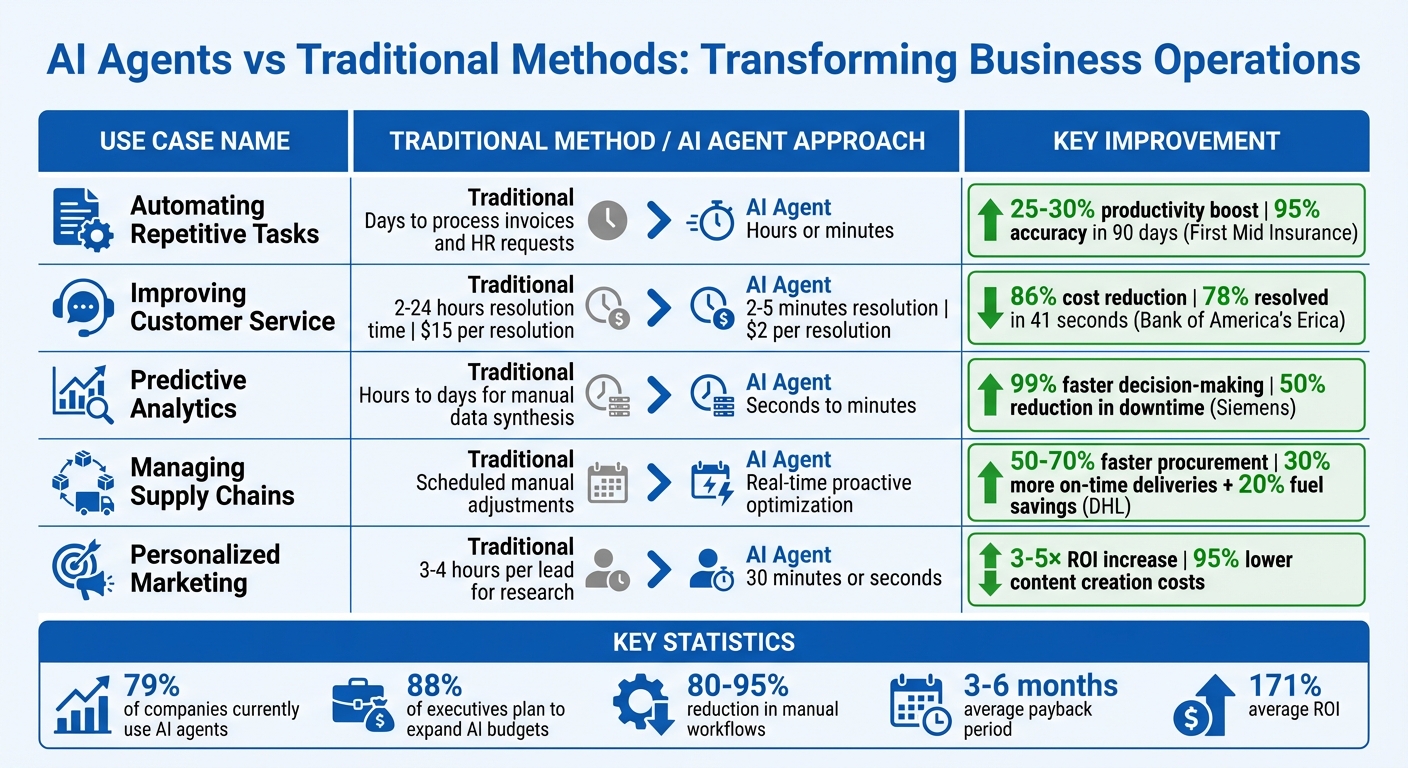
AI Agents vs Traditional Methods: Performance Comparison Across 5 Business Use Cases
AI Agents EXPLAINED in 14 minutes and TOOLS for building one
sbb-itb-8bb7924
1. Automating Repetitive Tasks
AI agents are revolutionizing how repetitive tasks are managed, saving time and effort. Everyday tasks like password resets, invoice processing, meeting scheduling, and lead qualification often eat up hours each week. Unlike humans, AI agents work nonstop, ensuring these tasks are completed efficiently and without breaks.
What sets AI agents apart from traditional automation is their ability to handle ambiguity instead of relying solely on strict "if-then" rules. For instance, if an invoice lacks a purchase order number, an AI agent can assess the situation, cross-check records, and determine the best course of action - all without needing human involvement. This level of reasoning significantly boosts operational efficiency.
Operational Efficiency Gains
The ability of AI agents to make informed decisions has transformed routine workflows. The results speak for themselves. Danfoss, for example, automated 80% of its email order processing, slashing response times from 42 hours to nearly instant. IBM's AskHR agent saved 12,000 hours in a single quarter by handling over 80 standard HR requests [3][6][8].
Organizations are also seeing dramatic reductions in manual workflows - up to 80–95% - when using workflow orchestration agents [5]. AI agents offer an impressive 4.2 times the coverage of human workers, operating 168 hours a week compared to the standard 40-hour workweek. Additionally, they can handle 70–90% of tier-1 support tickets, freeing up human employees to tackle more complex challenges.
Cost Reduction and ROI Impact
The financial benefits of AI agents are just as compelling. A single support call handled by a human typically costs $8 to $15, while an AI agent interaction costs only a few cents [4]. For a support team managing 50,000 tickets monthly, this translates to a cost drop from around $750,000 to just $100,000 per month [12]. On top of that, AI agents save over $114,000 annually per executive role [2], with many implementations paying for themselves within 3–6 months [2][11][12].
Take First Mid Insurance Group as an example. In 2026, they introduced a Nurix AI-powered training assistant to replace a daunting 200+ page manual. Within 90 days, the system achieved 95% accuracy in handling insurance workflows and boosted productivity by 25% [10]. Across industries, companies report productivity increases of up to 300% and cost savings of 70–95% compared to traditional human-driven operations [2][5].
2. Improving Customer Service
AI agents are transforming customer service by taking over routine tasks, allowing human teams to focus on more complex and empathy-driven interactions. Unlike older chatbots that often fail with unexpected queries, these AI systems can handle ambiguity and perform multi-step processes like processing refunds or updating account details across integrated platforms [4][9]. By managing these repetitive, high-volume tasks, AI agents free up staff for more strategic work.
Operational Efficiency Gains
The benefits of AI agents are clear when it comes to speed and accuracy. For example, Bank of America's AI assistant, "Erica", processes over 2 million customer requests daily and successfully resolves 78% of them in just 41 seconds on average [4]. Similarly, E.ON, an energy company, achieved a 70% automation rate for over 2 million customer calls by using AI for routine inquiries [4]. This kind of automation dramatically reduces resolution times from hours - sometimes up to 24 - down to just 2–5 minutes [5]. Companies also report a 60–80% reduction in routine support ticket volumes [1][9].
AI agents are available 24/7, providing instant responses regardless of time zones or holidays. They can manage unlimited conversations across multiple channels like phone, email, and chat [1][13]. Achieving this level of coverage with traditional staffing would require a significant and costly expansion of teams.
Beyond efficiency, these systems also provide valuable insights to improve customer interactions.
Real-Time Insights and Decision-Making
Modern AI agents do more than answer questions - they analyze customer sentiment, predict needs, and provide contextual insights during live interactions. In 2024, Verizon used generative AI to predict the reasons for 80% of incoming service calls in real-time, helping prevent roughly 100,000 customer defections that year [16]. Another example is Mobily, a Saudi Arabian telecom provider, which reduced customer wait times from 20 minutes to just 6 seconds for its 1.2 million customers by using AI-powered social media agents [16][10].
These AI tools also support real-time decision-making by offering next-best-action recommendations and instant access to customer histories. This capability allows human agents to handle 13.8% more inquiries per hour [17], while also cutting down on time spent on manual searches and post-call wrap-up tasks, which typically consume 17% of an agent's time [15].
These operational improvements don’t just save time - they also deliver measurable financial benefits.
Cost Reduction and ROI Impact
The cost savings from AI agents are striking. While human-handled calls typically cost $8–$15 each, interactions managed by AI cost just pennies [4]. Businesses adopting AI agents often see significant cost reductions, with payback periods ranging from just 2 to 4 weeks [1]. This makes AI agents one of the quickest ways to achieve a return on investment in customer service operations.
These advancements in customer service not only improve efficiency but also align with broader business transformations powered by AI solutions.
3. Using Predictive Analytics for Better Decisions
AI agents are reshaping decision-making by moving from reactive to proactive strategies, thanks to predictive analytics. Instead of waiting for problems like equipment failures or inventory shortages, these systems continuously analyze thousands of data points - such as supplier stability and sensor readings for temperature and vibration - to predict potential issues weeks in advance [18]. This approach enables organizations to operate more efficiently and avoid costly disruptions.
Operational Efficiency Gains
AI agents speed up decision-making dramatically, cutting the time needed from hours or days to mere seconds or minutes - a pace that’s 99% faster than traditional human-led processes [2]. For instance, in 2026, Healf, a Shopify-based brand, adopted Prediko's predictive planning AI agents to optimize inventory and demand management, yielding a 75x return on investment (ROI) by reducing manual forecasting and improving stock control [19]. Similarly, We Are Jolies leveraged AI forecasting to slash stockouts by 60% by accurately predicting demand and automating reorder processes [19].
The impact extends beyond inventory. Companies using AI for inventory management have seen forecast accuracy leap from 70% to 93% [19]. Predictive maintenance powered by AI has also shown impressive results, reducing infrastructure failures by 73%, cutting maintenance costs by 10–40%, and minimizing unplanned downtime by 35–45% [20]. Moreover, teams that previously spent 6–10 hours weekly on manual reporting have reclaimed nearly 90% of that time with automated AI reporting tools [27,28].
Real-Time Insights and Decision-Making
Modern AI agents go beyond identifying potential problems - they take action. They can initiate backup plans, switch suppliers, or adjust production settings when quality issues arise [18]. A prime example is JPMorgan Chase’s COIN platform, which autonomously processes loan agreements, saving the company an astounding 360,000 hours of manual work annually [13].
"Predictive quality control with AI agents can provide continuous monitoring with early warning systems to proactively identify defects, problems or issues."
- Nick Rahn, Enterprise Automation Expert, Centric Consulting [18]
AI agents also excel in delivering strategic insights. By analyzing factors like market trends, competitor pricing, and even weather patterns, they create dynamic forecasting models. For example, the Radisson Hotel Group implemented Gemini-powered AI agents in 2025 to automate ad localization across 1,520 hotels in 100 countries. This initiative boosted marketing team productivity by 50% and drove over 20% revenue growth through AI-driven campaigns [14]. Additionally, AI agents provide 4.2x more coverage than human teams [2].
Cost Reduction and ROI Impact
AI agents bring significant cost savings, particularly in financial management. Automated budgeting and forecasting can cut costs by 70% [2]. While hiring a human employee might cost $120,000–$200,000 annually, AI agents can start at just $6,000 per year - a staggering 95% reduction [2]. Entry-level inventory management AI plans are even more affordable, starting at $49 per month [19].
The financial benefits are clear. The average ROI for AI agent deployments is 171%, with most organizations recouping their investment within 3–6 months [2,27]. Businesses can save over $114,000 annually for each executive-level position replaced or augmented by AI [2]. In finance, AI solutions improve efficiency by 15–20%, including cutting invoice approval times by 33% and monthly close times by 25% [13].
4. Managing Supply Chains with AI
Supply chains are no strangers to disruptions - whether it’s port congestion, unexpected weather events, tariff changes, or supplier breakdowns. AI agents tackle these issues by operating in a continuous "sense-plan-act-learn" cycle, analyzing live data to respond effectively to changing conditions [21]. Unlike traditional automation, which struggles with unpredictable variables, AI agents adjust seamlessly [25][27]. By building on predictive analytics, these systems offer a new way to address real-time logistics challenges.
Operational Efficiency Gains
AI agents are reshaping how businesses handle supply chain complexities. Back in 2025, General Motors created a digital supply chain model capable of processing data from thousands of locations and millions of records in just 3.5 hours [27]. Companies using similar tools report modeling cycles that are 95% faster and see up to a 90% reduction in manual data edits thanks to automated workflows [27]. These systems also utilize Incremental View Maintenance (IVM), which processes only data changes rather than recalculating entire datasets, enabling quicker decisions on time-sensitive matters [22][25].
AI agents don’t stop there - they monitor weather, traffic, and geopolitical risks to detect disruptions and automatically recommend or execute solutions like rerouting shipments or shifting suppliers [18][26]. Early adopters have reported impressive results, including a 15% drop in logistics costs, a 35% reduction in inventory levels, and a 65% boost in service levels [18][22].
Scalability and Flexibility
Once AI agents establish effective decision patterns, they can rapidly apply them across various locations, products, or regions, offering agility that traditional systems simply can’t match [21][25]. For instance, United Rentals used AI to evaluate branch location opportunities, generating over 100 data-driven recommendations. This led to cost savings of 4–11% while also improving service levels [27]. This approach, often referred to as agentic design, allows companies to restructure their supply chain networks or sourcing strategies in days instead of months when market conditions shift [27].
"Planning optimizes the system you already have. Design finds you the system you should be running."
AI also promotes better cross-functional coordination. Specialized agents for procurement, logistics, and demand management share real-time data and context, breaking down operational silos and aligning decisions with shared goals [23][25]. A great example is UPS, which uses its ORION AI system to analyze data from over 125,000 vehicles. This system saves about 10 million gallons of fuel annually through real-time route optimization [26]. The scalability of AI ensures continuous monitoring and proactive adjustments, which are critical for today’s dynamic supply chains.
Real-Time Insights and Decision-Making
AI agents provide constant monitoring, enabling businesses to respond proactively before disruptions escalate. By integrating digital twins - virtual models of physical supply chains - they can simulate disruptions, test response strategies, and even predict supplier issues weeks in advance by analyzing financial and geopolitical signals [18][22]. Sixty-two percent of supply chain executives report faster decision-making with AI agents [22][25]. Companies heavily invested in AI-driven supply chain operations are seeing revenue growth 61% higher than their competitors [22][25].
The benefits don’t stop there. AI agents can improve real-time spend visibility by 43% and increase inventory turnover by over 30% [21]. With the global market for AI in supply chain management expected to hit $58.55 billion by 2031, growing at an annual rate of 40.4% [22], it’s clear that these innovations are driving both cost savings and better responsiveness.
Cost Reduction and ROI Impact
The financial impact of AI in supply chain management is hard to ignore. Smarter transportation mode selection and load consolidation enabled by AI can cut carbon emissions by 23.67% [26]. Return on investment (ROI) for these systems typically ranges from 8 to 18 months [22]. Additionally, 76% of Chief Supply Chain Officers believe automating repetitive tasks with AI will significantly boost process efficiency [25].
"The true ROI lies in decision velocity: collapsing the time between market signal and strategic response from weeks to minutes."
- Optilogic [27]
AI also drives savings through optimized routing, dynamic inventory rebalancing, and predictive maintenance, all of which reduce fuel costs, carrying costs, and equipment downtime [22][24][26]. Gartner projects that by 2028, 33% of enterprise software applications will include agentic AI, a sharp increase from less than 1% in 2024 [25].
5. Creating Personalized Marketing Campaigns
Marketing teams face the challenge of delivering tailored messages across multiple platforms, all while keeping up with the demand for scale. AI agents address this by automating workflows that handle data collection, validate tracking, analyze performance, create content variations, and initiate actions autonomously [28]. Unlike traditional automation systems that stick to rigid "if-then" rules, these agents use advanced reasoning to interpret new signals and make decisions based on context [29]. This approach allows personalized marketing to drive meaningful results.
Operational Efficiency Gains
AI agents streamline processes by removing the need for manual coordination and reducing delays caused by cross-team handoffs [29]. For example, AI-generated campaign briefs now incorporate organizational goals and brand guidelines instantly [31]. Weekly reporting, which once required hours per channel, can now be consolidated into a single workflow completed in minutes [28]. In 2025, two-thirds of enterprises reported major productivity improvements from AI adoption, with advanced AI agent programs cutting campaign launch times by 30–50% [29][33].
Scalability and Flexibility
What makes AI agents truly powerful is their ability to scale personalization efforts. They can create thousands of content variations - emails, subject lines, or calls-to-action - in a matter of seconds, far beyond what human teams can manage [31]. These agents also simulate multiple buyer roles, identifying gaps and drafting tailored sequences for various stakeholders [33]. Considering that 86% of B2B purchases stall [33], this capability to engage multiple decision-makers with relevant messaging is crucial. Generative AI is projected to contribute $4.4 trillion annually to global productivity, with marketing and sales being key beneficiaries [30]. This means businesses can increase their campaign output and speed without needing to expand their teams proportionally [29][33].
Real-Time Insights and Decision-Making
AI agents transform marketing from reactive dashboard monitoring to proactive decision-making. They detect intent signals and trigger personalized responses while continuously optimizing aspects like targeting, budgets, and messaging based on live performance data [28][29][30]. This ability to make quick, informed decisions - referred to as decision velocity - is becoming a critical competitive edge.
"The biggest competitive gap in marketing won't be creativity or spend: it will be decision velocity."
- Nayanika Ghatak, Sr. Product Marketing Manager, Uniphore [34]
By 2028, at least 15% of daily work decisions are expected to be made autonomously through AI agents, up from 0% in 2024 [32]. Personalized email campaigns are already showing impressive results, generating six times higher transaction rates, and 80% of consumers say they are more likely to buy from brands that offer personalized experiences [38].
Cost Reduction and ROI Impact
AI agents also help reduce costs by automating audience segmentation and ensuring campaigns are executed on time [35]. They can reallocate ad budgets across platforms in real time, optimizing for ROI and cutting underperforming spend faster than human analysts could [30][34]. For instance, using AI agents for lead qualification has been shown to boost conversion rates by 35%, while automated campaign optimization can double the ROI of ad campaigns [37]. The market for AI in marketing is expected to grow to $217.33 billion by 2034, underscoring the shift toward autonomous marketing solutions [36].
Comparison Table
AI agents bring measurable improvements to key operations. The table below highlights how AI agents surpass traditional methods in five critical use cases.
| Use Case | Traditional Method | AI Agent Approach | Improvement |
|---|---|---|---|
| Automating Repetitive Tasks | Days to process invoices and HR requests [3] | Hours or minutes [3] | 25–30% productivity boost; First Mid Insurance Group achieved 95% accuracy with a 25% productivity gain in under 90 days [10] |
| Improving Customer Service | 2–24 hours average resolution time; $15 per resolution [5][12] | 2–5 minutes average resolution; $2 per resolution [5][12] | 86% cost reduction; Bank of America's Erica resolves 78% of customer questions in 41 seconds [4] |
| Predictive Analytics | Hours to days for manual data synthesis [2] | Seconds to minutes [2] | 99% faster decision-making; Siemens reduced unplanned downtime by 50% [4] |
| Managing Supply Chains | Scheduled manual adjustments [4] | Real-time proactive optimization [4] | 50–70% faster procurement cycles; DHL achieved 30% more on-time deliveries and 20% fuel cost savings [4] |
| Personalized Marketing | 3–4 hours per lead for research and qualification [3] | 30 minutes or seconds [3] | 3–5× ROI increase; 95% lower content creation costs [8] |
The data makes it clear: AI agents excel in productivity, cost savings, and speed across every use case.
"Average cost per customer resolution: $15 with humans. $2 with an AI agent." - Braincuber Editorial [12]
For example, automating 10,000 monthly support tickets could save businesses between $50,000 and $500,000 annually [5]. With payback periods averaging just 4 to 6 months [12], the financial benefits are undeniable. Real-world examples from various industries back up these claims, showcasing the transformative potential of AI.
This comparison underscores a key takeaway: AI agents outperform traditional methods in speed, cost efficiency, and operational effectiveness.
Conclusion
AI agents are transforming how businesses operate, driving some of the most impressive productivity advancements in recent years[9]. By automating routine tasks, organizations can cut task completion time by up to 80%, reduce costs by as much as 30%, and achieve productivity increases of up to 300%[2][4].
Currently, 79% of companies have integrated AI agents into their processes, and 88% of senior executives plan to expand their AI budgets within the next year[4][7]. These tools provide a clear edge: businesses using AI agents report a 66% boost in productivity and 57% in cost savings[7]. On an individual level, employees save 40–60 minutes daily by handing off repetitive tasks to AI agents[4]. Beyond time savings, AI agents drive revenue growth by qualifying leads, tailoring outreach, and identifying cross-sell opportunities in real time. From task automation to marketing optimization, their impact is measurable and far-reaching.
AgentBandwidth’s specialized AI agents exemplify this shift. Solutions like JobVantage streamline job discovery, EdgeFlow enhances market analysis, and ClaimPath simplifies health insurance appeals. These agents combine deep domain expertise with seamless collaboration in a unified network, offering 24/7 operational support and real-time decision-making - exactly what modern businesses need.
The real question isn’t whether AI agents are necessary but how quickly they can be implemented. Early adopters are already enjoying major efficiency gains and cost reductions, securing a strong position in today’s competitive landscape.
FAQs
How do I pick the best first AI agent use case for my business?
When deciding on your first AI agent use case, it’s important to target areas where AI can deliver noticeable results within 6–12 months. Think about tasks like process automation or customer service, where efficiency and measurable outcomes are key.
Start by narrowing your focus to specific workflows that can show a clear return on investment (ROI). Having access to sufficient, high-quality data is also crucial for success. If you're unsure about fully automating a process right away, consider beginning with a human-in-the-loop approach. This allows humans to oversee and guide the AI, ensuring better accuracy and smoother implementation.
By selecting a focused, impactful use case that’s easy to manage, you’ll set the stage for successful AI adoption and real, tangible benefits.
What data and system access do AI agents need to work well?
AI agents thrive on both structured and unstructured data - think customer details, transaction records, and operational information. This data forms the backbone of their ability to analyze situations and make informed decisions.
To function seamlessly, these agents need to integrate with systems like ERP (Enterprise Resource Planning), CRM (Customer Relationship Management), and content management platforms. Such integration allows them to automate workflows and handle tasks efficiently.
Secure access is another critical piece of the puzzle. Whether through APIs, databases, or cloud services, AI systems must have access pathways that are both reliable and protected. Strong authentication measures and strict data governance frameworks are non-negotiable when it comes to safeguarding sensitive information.
How do I measure ROI and payback for an AI agent rollout?
To effectively measure ROI and payback, start by identifying specific, measurable outcomes. These could include cost savings, increased revenue, or improvements in efficiency - all within a 6–12 month timeframe.
Set clear KPIs that align with your goals, and consistently track the costs of implementation against the benefits achieved. Many organizations report seeing ROI within the first year of execution.
Make it a habit to regularly analyze performance data. Use these insights to fine-tune workflows and ensure you're maximizing results over time.