
AI Automation vs Manual Workflows: Which Saves More Time?
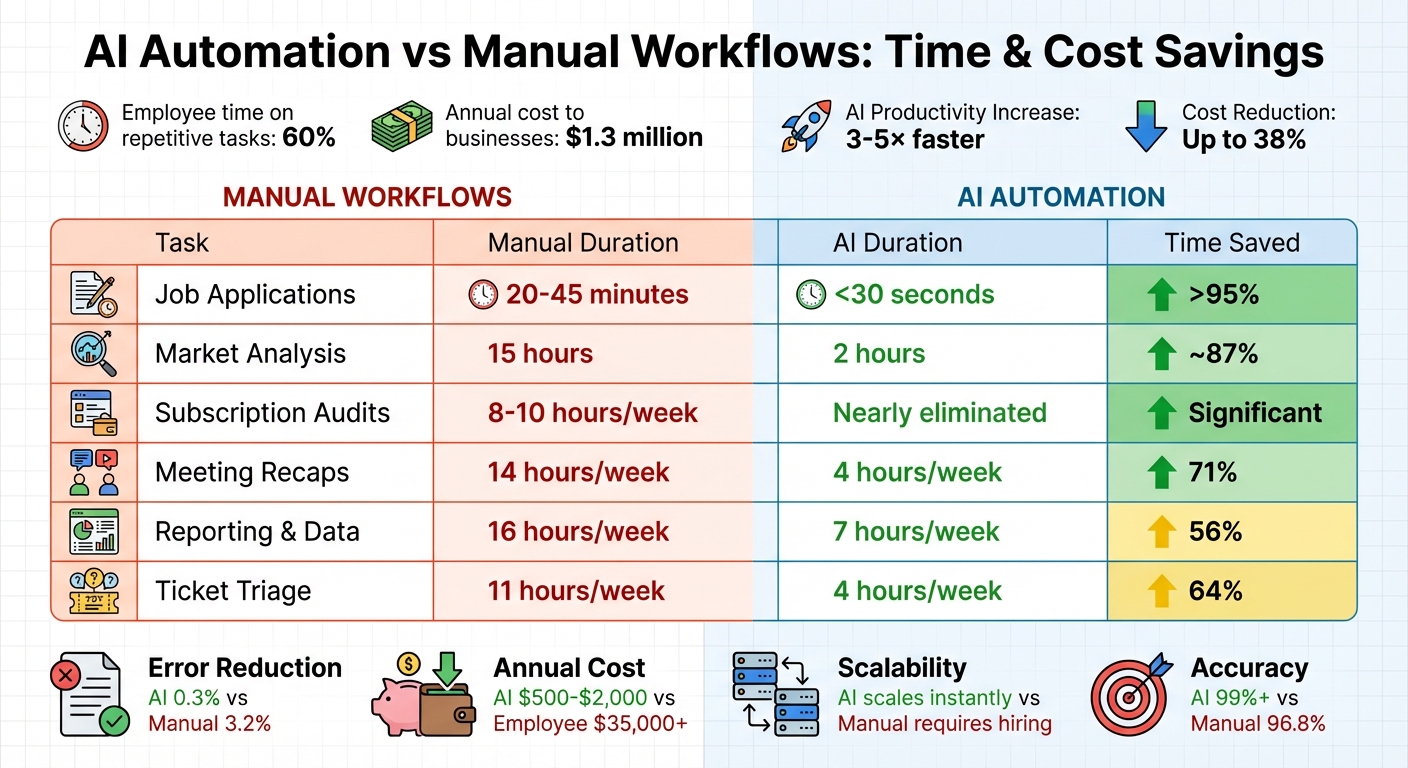
AI automation can save 3–5× more time than manual workflows while reducing costs by up to 38%.
Manual workflows are time-consuming, error-prone, and costly. Employees spend 60% of their time on repetitive tasks, costing businesses an average of $1.3 million annually. AI tools like JobVantage, SubScan, and EdgeFlow handle tasks in seconds, drastically cutting time spent on job applications, subscription audits, and market analysis.
Key Insights:
- Time Savings: AI reduces task durations by 50–95%, e.g., job applications drop from 20–45 minutes to under 30 seconds.
- Error Reduction: AI minimizes mistakes, with error rates as low as 0.3%, compared to 3.2% for manual processes.
- Scalability: Unlike manual workflows, AI scales instantly without added costs or delays.
- Cost Efficiency: AI agents cost $500–$2,000 annually, far less than hiring additional staff.
Quick Comparison:
| Workflow Task | Manual Duration | AI Duration | Time Saved |
|---|---|---|---|
| Job Applications | 20–45 minutes | < 30 seconds | >95% reduction |
| Market Analysis | 15 hours | 2 hours | ~87% reduction |
| Subscription Audits | 8–10 hours/week | Nearly eliminated | Significant savings |
AI doesn’t just save time - it reduces errors, handles demand spikes effortlessly, and allows professionals to focus on more meaningful work. Whether it’s automating job searches, subscription tracking, or data analysis, AI transforms workflows and boosts productivity.
AI vs Manual Workflows: Time Savings and Cost Comparison
AI vs Manual Testing - Which Saves More?
sbb-itb-8bb7924
Time Consumption: AI vs Manual Workflows
This section highlights the measurable time savings achieved when AI replaces manual workflows, building on the earlier discussion about automating repetitive tasks.
Task Duration Comparison: Manual vs AI
The time difference between manual processes and AI-powered workflows is striking. Let’s break it down: tasks like meeting recaps and next steps, which consume 14 hours weekly when done manually, drop to just 4 hours with AI - a 71% time reduction[1]. Similarly, reporting and data narration is cut from 16 hours to 7 hours per week, saving 56% of the time[1], and ticket triage shrinks from 11 hours to 4 hours weekly, a 64% reduction[1]. These figures are drawn from real-world applications.
Here’s how specific tasks compare:
| Workflow Task | Manual Duration | AI Duration | Time Saved |
|---|---|---|---|
| Job Applications (CV Formatting) | 20–45 minutes | < 30 seconds | >95% reduction [8] |
| Market Analysis (Client Reporting) | 15 hours | 2 hours | ~87% reduction [4] |
| Subscription Audits (Invoice Processing) | 8–10 hours per week | Nearly eliminated | Significant time savings [9] |
AgentBandwidh's tools exemplify these improvements. JobVantage, for instance, reduces the time spent on job discovery and application formatting from 20–45 minutes to under 30 seconds[8]. SubScan simplifies subscription audits, slashing the 8–10 hours typically required for manual invoice tracking each week[9]. Similarly, EdgeFlow condenses a 15-hour client reporting process into just 2 hours, delivering actionable insights much faster[4].
These time savings highlight how AI transforms workflows, setting the stage for concrete case studies.
Case Study: Time Savings with AgentBandwidh
To illustrate, a 12-person agency using Rivulet IQ’s AI workflow in January 2026 saved an impressive 40 hours per week. The system automated tasks like meeting recaps, reporting narration, and ticket triage, showcasing how AI significantly boosts operational efficiency[1].
Another example comes from JetBlue’s contact center, which introduced a generative AI chatbot in August 2025. This tool reduced the average customer chat time by 4.7 minutes, saving 73,000 agent hours in just one quarter[9]. Similarly, Unilever implemented an AI-driven hiring program that filtered over 250,000 applications in 18 months, saving more than 50,000 hours of interview time. This program also slashed the time-to-hire from four months to just a few weeks - a 90% reduction[9].
These examples underscore the immense time savings AI can deliver, reshaping operations across industries.
Accuracy and Error Reduction: A Time-Saving Benefit
AI automation isn’t just about speed - it’s also about cutting down on errors that eat up time and resources. Manual workflows don’t just take longer; they come with a built-in risk of mistakes that require extra hours to spot and fix. These "hidden costs" can drain resources that could be better spent on more strategic tasks.
The Cost of Manual Errors
Consider this: manual data entry errors occur at an average rate of 3.2%, with each mistake taking about 18 minutes to fix. For a logistics company, this translates to 10.8 hours lost every week and an annual cost of around $15,120[10]. Common errors include transposed numbers (34%), incorrect vendor mapping (28%), and missing fields (19%)[10][12].
In healthcare claims processing, the stakes are even higher. Manual workflows can have error rates between 12% and 18%, causing claim denial rates to spike to 20%–30%[11]. Fixing these denials is no small task - resubmitting a single claim manually can take up to 10 business days[11]. For example, in January 2025, a California-based medtech startup faced a backlog of 3,000 denied claims. Each manual resubmission required 6 minutes of staff time, creating a significant bottleneck[14]. Similarly, a 2026 newsroom audit by Ninth Post found that manual workflow issues, like reconciliation errors and lead triage delays, cost them $50,000 annually[3].
These examples show how manual errors don’t just waste time - they inflate operational costs and slow down processes, making AI’s precision a game-changer.
How AI Precision Reduces Rework
AI addresses these inefficiencies by minimizing errors and cutting rework to a fraction of what manual processes require. With error rates as low as 0.3% to 2%[10][11], AI tools use anomaly detection and domain-specific logic to catch potential mistakes before they happen. For instance:
- SubScan cross-checks line item totals and flags discrepancies that might slip through manual reviews.
- ClaimPath uses confidence scoring to identify low-quality scans or illegible handwritten notes, routing them for human review instead of letting them cause downstream errors.
That same medtech startup used AI to tackle its 3,000-claim backlog. In just three weeks, the system cleared 80% of the backlog, reduced manual rework by 90%, and slashed claim processing times from 6 minutes to just 30 seconds per claim[14]. Within a month, coding errors dropped by 80%, denial rates fell by 70%, and resubmission times shrank from 10 business days to just 24–48 hours[11].
"AI agents reduce rework - the most expensive hidden cost in enterprises." - Quixy Editorial Team[13]
Ninth Post also saw dramatic results after deploying an "Agentic Stack" powered by Retrieval-Augmented Generation (RAG). By connecting AI to verified internal documents instead of relying solely on probabilistic methods, they eliminated 90% of factual errors in research and data reconciliation. This reduced overall error rates by 74% and sped up editorial research by 41%[3]. The $50,000 they saved annually came directly from cutting time spent on corrections.
AgentBandwidh’s AI tools bring similar advantages across industries. For example:
- JobVantage ensures resumes are formatted to meet specific job requirements, eliminating the need for manual reviews.
- EdgeFlow validates market data against multiple sources, preventing costly errors in client reports.
- Court Support tracks legal deadlines with precision, avoiding missed filings that could derail entire cases.
Switching to AI-powered workflows doesn’t just speed things up - it eliminates the wasted hours spent fixing errors, freeing up teams to focus on tasks that truly matter.
Scalability and Flexibility: AI's Time Efficiency Advantage
AI doesn't just reduce errors - it also offers unmatched scalability, making it a powerful tool for saving time. When demand surges, manual workflows often struggle to keep up, while AI systems adapt effortlessly. The contrast lies in how each approach handles growing workloads and the hidden expenses tied to scaling up.
Manual Scaling Limitations
Scaling manual processes usually means hiring more staff. But this isn’t quick or cheap - recruitment, onboarding, and training take time, causing delays in meeting increased demand. On top of that, relying on overtime can lead to employee burnout.
Manual workflows also tend to grow in direct proportion to input. As demand rises, costs often grow even faster than revenue[12]. For instance, hiring a junior employee can cost over $35,000 annually before factoring in benefits, management costs, and training. In comparison, an AI agent might cost between $500 and $2,000 per year - just a fraction of the expense[4]. It’s no wonder that 43% of small and mid-sized businesses cite operational inefficiencies as their biggest obstacle to scaling[4].
Another challenge is knowledge dependency. Manual systems rely heavily on individual employees. If a key team member is unavailable or leaves, operations can stall[12][1]. Take Nexus Digital as an example: in August 2025, the mid-sized marketing agency faced 12–48 hour delays in processing leads because their manual workflows couldn’t keep up. This led to an 80% loss of leads to faster competitors[4].
"Growth exposes weaknesses in workflows faster than anything else. And because manual processes scale linearly with effort, costs rise faster than revenue." - Automation Agency[12]
AI automation eliminates these bottlenecks, offering a solution that scales effortlessly.
How AI Automation Scales Instantly
AI doesn’t need hiring, training, or overtime. It adjusts to demand spikes without additional staffing or infrastructure costs[15][16]. For example, when Nexus Digital implemented an AI agent for lead scoring and engagement, response times dropped from hours to under 90 seconds. In just six weeks, their conversion rate jumped from 12% to 28%, all without hiring extra staff[4].
Klarna’s AI customer service assistant is another success story. In early 2025, it managed 2.3 million customer interactions in its first month, effectively doing the work of 700 full-time agents. Average resolution times dropped from 11 minutes to under 2 minutes, with the system running 24/7 in multiple languages[7]. Similarly, an Intercom client saw a 690% surge in support requests in 2025, yet their AI agent maintained a 98.3% self-service rate[6].
AgentBandwidth’s modular tools demonstrate similar scalability. JobVantage can process hundreds of job applications at once, SubScan audits thousands of subscription line items simultaneously, and EdgeFlow analyzes market data in real time. In January 2026, a 12-person partner agency used these tools to automate repetitive tasks, saving 40 hours per week - the equivalent of adding a full-time employee - without expanding their team[1].
The takeaway is simple: while manual workflows require significant resources to scale, AI automation scales instantly, handles demand spikes effortlessly, and operates at a fraction of the cost of human labor.
AgentBandwidh's Time-Saving Applications
AgentBandwidh's specialized agents are designed to drastically reduce the time spent on tedious tasks in areas like job hunting, subscription management, and market analysis. What once took hours can now be accomplished in mere minutes, thanks to these AI-driven tools.
JobVantage: Streamlining Job Searches and Applications
Job hunting is notoriously time-consuming, with tasks like reading job postings, customizing resumes, and drafting cover letters taking an average of 40 minutes per application[18]. JobVantage simplifies this process, cutting the time to just 9 minutes by automating repetitive steps.
Here’s how it works: the system scans job boards using your keywords and matches each listing against your master resume using AI scoring. In just 10 minutes, it can evaluate 50 jobs - a task that would take hours if done manually[17]. For roles with high scores (7/10 or above), JobVantage generates tailored cover letters in 2 minutes and adjusts resume bullet points in 5 minutes, tasks that traditionally require 10 and 20 minutes, respectively[18].
For example, in September 2025, developer Kumarvatsal created an AI recruitment agent that analyzed over 300 job postings in its first week. It identified 45 strong matches, resulting in 22 applications and five interview requests - all within seven days[17].
"Job search feels emotional. But the pain is also mechanical... repetitive operations are exactly where automation can create ROI." - Dora, job search consultant[18]
This tool highlights how automation can take the hassle out of job hunting, saving time without sacrificing quality.
SubScan: Simplifying Subscription Audits
Manually auditing subscriptions can be a headache. Tasks like exporting 90 days of transactions, spotting recurring charges, and grouping vendors can take 60 to 90 minutes[20]. SubScan tackles this in a fraction of the time, processing the same data in seconds or minutes.
Using AI, SubScan quickly reads transaction data and ranks subscriptions by cost and potential waste[19][20]. This approach is 96% faster than manual methods, offering speeds up to 450 times quicker than traditional entry[10][19]. On average, users uncover $50 to $300 in immediate monthly savings, with some identifying up to $500 in hidden costs[20]. Even better, SubScan's accuracy exceeds 99%, far outpacing the 3.2% error rate of manual audits[10][19].
By automating these audits, SubScan not only saves time but also helps businesses uncover savings they might otherwise miss.
EdgeFlow: Speeding Up Market Analysis
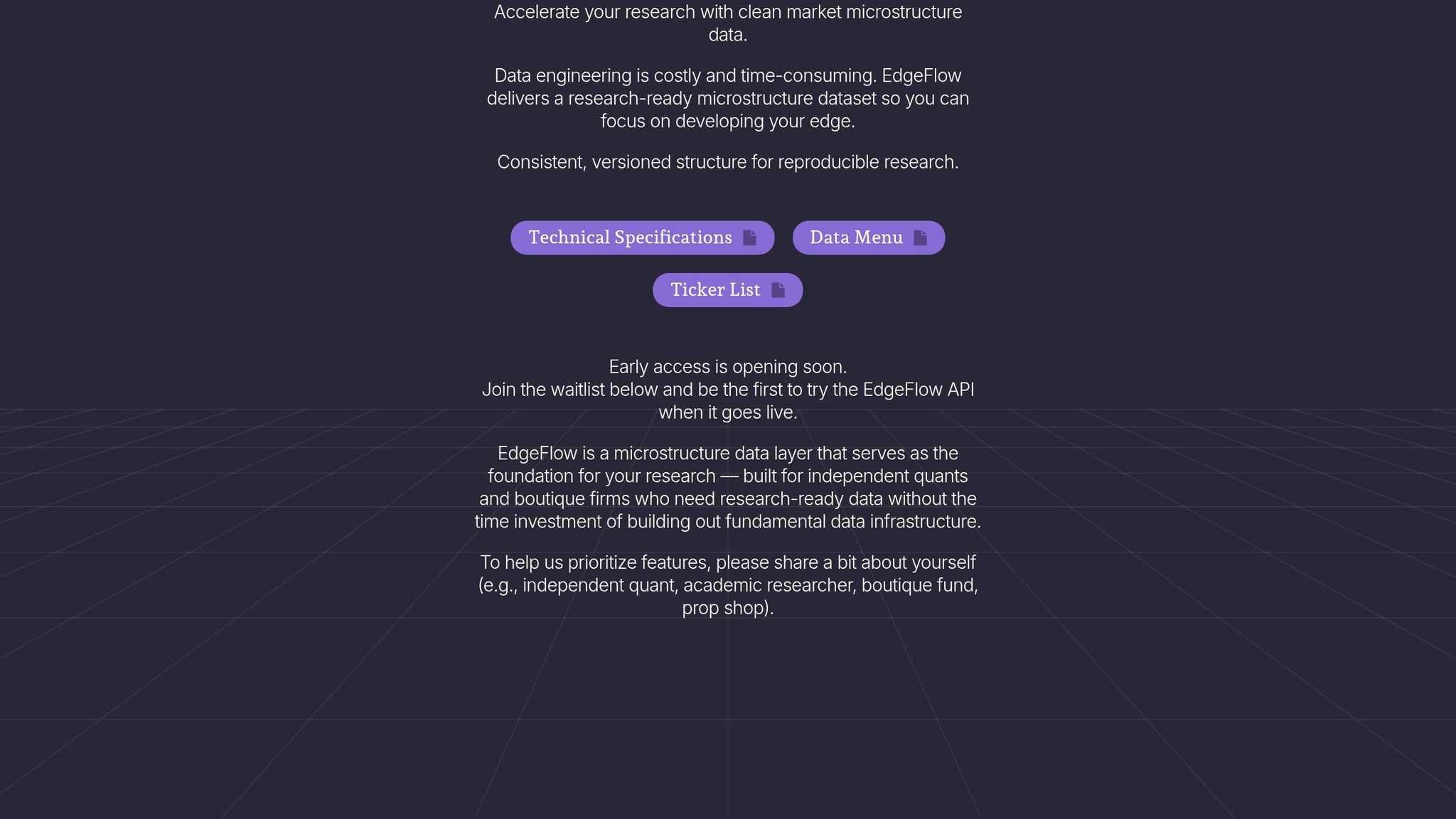
Market research often suffers from delayed data. For instance, SEC Form 13F filings - used to track institutional trades - can arrive up to 135 days after the trades occur[21]. EdgeFlow eliminates this lag by providing real-time analysis of every trade across the S&P 500, delivering insights minute by minute[21][22].
This tool gives users a 45- to 135-day advantage over traditional methods that rely solely on public filings. EdgeFlow’s algorithms boast a 65.5% accuracy rate in predicting quarterly institutional moves, climbing to 71.1% for high-confidence signals[21]. Unlike delayed reporting, EdgeFlow offers actionable intelligence in real time.
"While your competitors wait 135 days for public filings, you could be acting on institutional flow intelligence today." - Exponential Technology[21]
By turning delayed data into real-time insights, EdgeFlow empowers users to stay ahead in competitive markets.
AgentBandwidh’s tools demonstrate how AI can transform labor-intensive workflows into fast, efficient processes, making them indispensable for anyone looking to save time and boost productivity.
Conclusion: AI Automation vs Manual Workflows
By early 2026, data shows that AI automation can increase productivity by 3–5× and reduce operational costs by up to 38% [23][24]. This shift allows businesses to reassign human expertise to strategic roles, leaving repetitive tasks to AI systems [3][25].
The numbers back up these benefits. Workers are saving several hours each week [7], and teams in areas like support, legal, and compliance are seeing massive reductions in time spent on routine tasks [7][2]. Interestingly, hybrid human-AI workflows outperform fully automated systems by 68.7% [6]. However, over-reliance on end-to-end automation without proper checkpoints can actually reduce efficiency by 18%, mostly due to the time spent on verification [5].
"Agentic AI marks the transition from digital tools to digital labor. This is not just another software layer - it's a new operating model." - Samuel Edwards, CMO, Automatic.co [24]
AgentBandwidh's suite of specialized agents highlights the power of this hybrid approach. Their tools efficiently handle tasks like job discovery, subscription audits, and market analysis, cutting down on micro-delays and hidden inefficiencies that manual workflows often face [3]. These measurable improvements pave the way for actionable strategies.
Key Takeaways
When it comes to AI workflows, accuracy and speed are both critical. While AI agents are 8–9× faster than humans at computer-based tasks, their accuracy rate is only about 47%, compared to humans' 85% [5]. This is why a hybrid approach works so well: AI manages repetitive, programmable tasks, while humans provide the oversight and judgment needed for success. Starting with Tier-1 tasks like data cleaning, boilerplate generation, and routine triage can help avoid the "automation paradox", where the time spent reviewing AI's work outweighs the time saved [5].
The financial upside is also hard to ignore. AI agents cost between $500 and $2,000 annually - just 6% of a junior employee's salary - but they operate 24/7 without fatigue or loss of focus [4]. Companies like Ninth Post have reported savings of around $50,000 annually by using agentic tools for support and data reconciliation [3]. Similarly, Esusu has automated 64% of customer interactions, cutting resolution times by 34% [6].
These insights provide a clear path forward for integrating AI into your workflows.
Next Steps
Start by auditing your current workflows to identify repetitive tasks - what some call "toil buckets" - that consume valuable time. Use a simple ROI formula (Frequency × Minutes per occurrence × Risk factor) to prioritize tasks for automation [1]. Focus on areas where AI can produce drafts for human review rather than aiming for full automation. AgentBandwidh's specialized agents are designed to excel in these scenarios, consistently delivering efficiency gains.
Whether you're managing job applications, subscription audits, or market research, AgentBandwidh's tools can take over the mechanical work, allowing you to focus on strategic decisions. Transitioning to AI-powered workflows is about rethinking how work is done, eliminating bottlenecks, and freeing up capacity for more meaningful activities [24].
FAQs
Which tasks should I automate first?
Automating tasks that are repetitive, take up a lot of time, or are error-prone can lead to major time savings and improved accuracy. Think about processes like data entry, handling routine customer inquiries, or document processing - these are perfect candidates for automation. By automating these, you can free up hours every month, minimize mistakes, and allow your team to concentrate on more strategic, high-value work.
Tasks that demand quick responses or precise execution, such as customer support chats or document reviews, are also great options for automation. These solutions not only speed up the workflow but also ensure consistent quality.
How much human review does AI still need?
AI tools can help simplify tasks, but they’re not perfect. They might occasionally produce results that are incomplete or fall short in quality. That’s where human review becomes essential. By stepping in, humans can spot and fix errors, ensuring the final outcome meets the desired standards and maintains accuracy.
How do I calculate ROI for automation?
Calculating ROI for automation involves a straightforward formula: take the hours saved per week, multiply by the hourly rate, then by 52 weeks, and subtract the associated costs. Here's the formula broken down:
(hours saved/week × hourly rate × 52) - (build cost + annual API costs)
This approach helps you estimate the annual savings and determine if the investment is worth it. Many businesses find that automation pays for itself quickly - sometimes within just a few months. To get an accurate ROI, focus on the time saved and translate that into its monetary value.