
Domain-Specific AI vs General AI: Key Differences
Domain-specific AI and general AI serve different purposes. Domain-specific AI, or vertical AI, focuses on specialized tasks within industries like healthcare, finance, and law. It uses tailored datasets, integrates with industry workflows, and ensures compliance with regulations. General AI, on the other hand, is designed for broad tasks across multiple domains but often lacks the precision needed for high-stakes applications.
Key Points:
- Domain-specific AI excels in accuracy and efficiency for specialized tasks.
- General AI offers flexibility but struggles with industry-specific requirements.
- By 2025, enterprise spending on vertical AI reached $3.5 billion, while 75% of general AI projects failed to deliver ROI.
- Industries like healthcare and finance rely on domain-specific AI for critical workflows, while general AI is better suited for general tasks like content creation.
Quick Comparison:
| Feature | Domain-Specific AI | General AI |
|---|---|---|
| Focus | Industry-specific tasks | Broad, multi-domain tasks |
| Accuracy | 95%–99% in specialized tasks | 70%–90% across diverse tasks |
| Training Data | Expert-curated, industry-specific | Public, diverse datasets |
| Compliance | Built-in for regulations (e.g., HIPAA) | Limited or requires customization |
| Deployment Time | Days to weeks | Months |
| Cost Efficiency | Lower operational costs | Higher costs due to token usage |
| Best Use Case | Healthcare, finance, legal | Content creation, brainstorming |
Choosing the right AI depends on your goals. Use domain-specific AI for precision in regulated industries and general AI for flexible, everyday tasks.
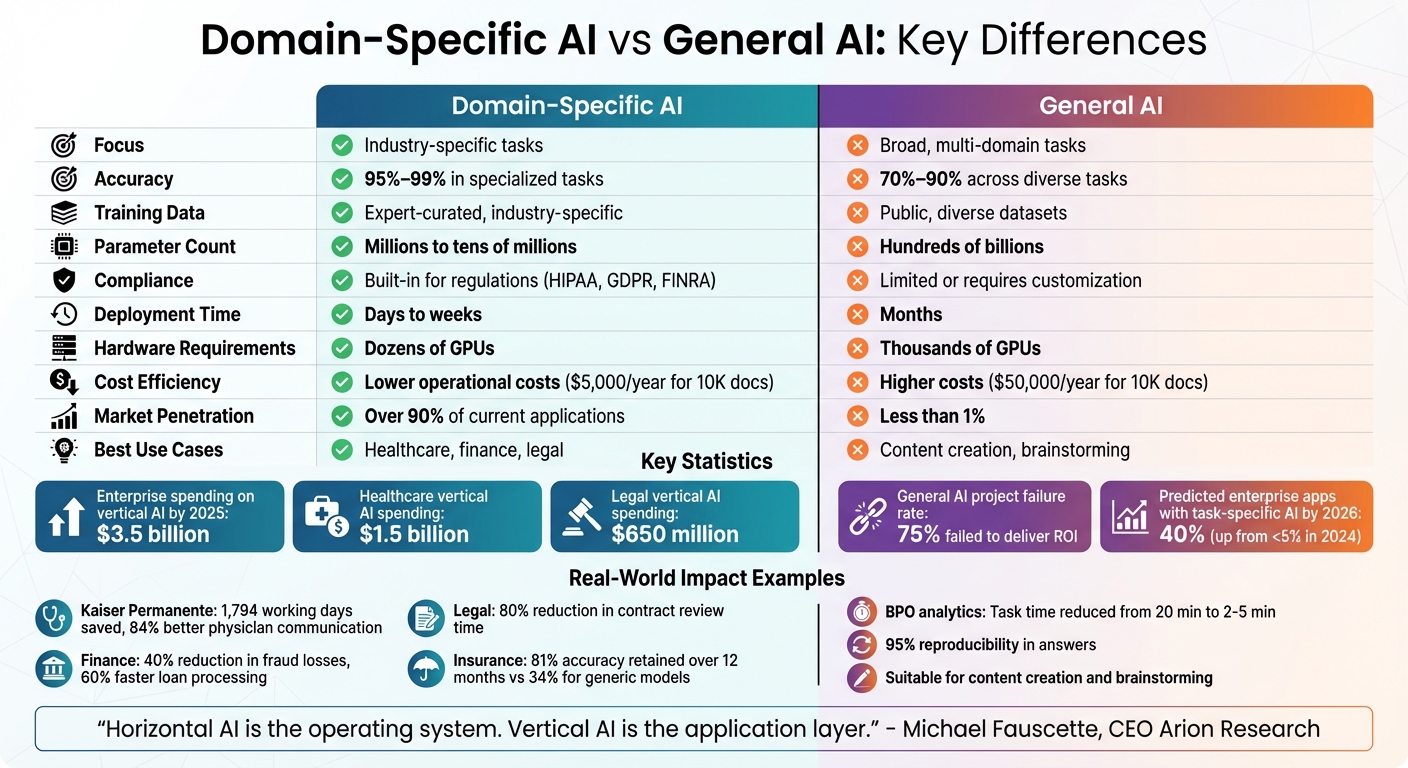
Domain-Specific AI vs General AI: Complete Feature Comparison
The Future of Domain-Specific AI: Building Effective Agents for Specialized Applications
sbb-itb-8bb7924
What is Domain-Specific AI?
Domain-specific AI - often called vertical AI - is designed to excel in specific tasks within a particular industry or area of expertise. Unlike general-purpose AI, which aims to tackle a wide range of problems, these systems prioritize depth over breadth. Think of it like comparing a Swiss Army knife to a surgical scalpel: one is versatile, while the other is built for precision.
These systems rely on specialized, industry-specific data and workflows, capturing nuances that broader, generalized models often miss [1][7]. Michael Fauscette, Founder & CEO of Arion Research, explains it well:
"Horizontal AI is the operating system. Vertical AI is the application layer" [7].
Domain-specific AI goes beyond simple interactions. It can execute complex, multi-step workflows autonomously. For instance, in the insurance industry, such AI can process claims, identify errors, and even generate appeals following established protocols, rather than merely answering questions about the process [7][5].
The numbers tell a compelling story. By 2025, healthcare alone accounted for $1.5 billion in enterprise spending on vertical AI [7][6]. Companies founded after 2019 in this space are growing at a staggering 400% year-over-year, with gross margins of around 65% [6]. Gartner also predicts that by 2026, 40% of enterprise applications will feature task-specific AI agents, a sharp increase from less than 5% in 2024 [6].
Main Features of Domain-Specific AI
Domain-specific AI systems are built for task specialization. They’re not designed to be generalists but instead focus on delivering expert-level performance in areas like medical claims processing, legal contract analysis, or fraud detection. This specialization allows them to outperform general-purpose models in their respective fields.
One of their defining traits is the use of expert-curated datasets. These datasets - such as those labeled by radiologists or reviewed by legal professionals - help the AI identify patterns that general models, trained on broader internet data, might overlook [12][13].
Another key feature is the integration of industry-specific workflows and datasets. These systems often fine-tune foundation models or use techniques like Retrieval-Augmented Generation (RAG) to ground their outputs in accurate, domain-relevant facts and regulations [2][11]. They also seamlessly integrate with tools like Electronic Health Records (EHRs) in healthcare or Customer Relationship Management (CRMs) in sales, making them practical for day-to-day use [15][16].
Regulatory compliance is baked into these systems, with guardrails to meet standards like HIPAA, GDPR, or FINRA, minimizing the risk of high-stakes errors [15][11].
Take AgentBandwidth’s modular agents as an example. Each one is tailored for specific industries:
- ClaimPath: Handles healthcare insurance appeals, parsing denial letters, generating appeals, auditing Explanation of Benefits (EOBs), and managing deadlines.
- EquityIQ: Focuses on equity modeling for startups, handling tasks like parsing term sheets, calculating vesting schedules, and modeling exit scenarios.
- JobVantage: Automates job searches, identifies ghost listings, crafts tailored resumes, and tracks applications.
Each agent is built with domain-specific intelligence, delivering precision that general AI cannot match. These systems have already demonstrated success in industries like healthcare, law, and finance.
Domain-Specific AI in Action
The real-world impact of domain-specific AI is hard to ignore. In April 2025, Kaiser Permanente implemented an AI-powered scribe system across 7,260 physicians, handling 2.5 million patient encounters. This system automatically created clinical notes from doctor-patient conversations, saving the equivalent of 1,794 working days. The results? 84% of physicians reported better communication, and 82% experienced increased job satisfaction [6].
In the legal world, Harvey, backed by the OpenAI Startup Fund, partnered with major law firms in 2025. Using AI trained on centuries of case law and private archives, Harvey drafts contract clauses that align with regulatory updates, cutting contract review times by over 80% [7][16].
The financial sector has also seen major benefits. Banks employing vertical AI have reduced fraud losses by 40% and sped up loan processing times by 60% [15]. For example, Feedzai uses AI to analyze transaction patterns in real time, detecting sophisticated fraud schemes that general models might miss.
In healthcare, Aidoc introduced AI agents in radiology departments in 2025 to analyze CT scans for intracranial hemorrhages. By prioritizing urgent cases for immediate review, the system’s ROI is measured not just in cost savings but in lives saved [7].
Another key advantage of domain-specific AI is its ability to maintain accuracy over time. In the insurance industry, fine-tuned models retained 81% accuracy over 12 months, while generic models dropped to 34% due to data drift [17]. This reliability translates to a 25% higher ROI for companies using vertical AI compared to those relying solely on general-purpose solutions [15].
What is General AI?
General AI, also known as Artificial General Intelligence (AGI), is a concept of AI designed to perform any intellectual task that a human can handle. This means it could learn from its surroundings and apply knowledge across a wide range of tasks - like diagnosing a medical condition one moment and drafting a legal document the next - without requiring specialized training for each task [8]. Unlike domain-specific AI, which is tailored for specific tasks, General AI aims to be adaptable across various domains. It also strives to include a "Theory of Mind", enabling machines to understand human emotions, intentions, and behaviors, which could lead to more natural and empathetic interactions [4].
However, AGI remains a theoretical goal. Current advanced systems, such as GPT-4, Claude, and Gemini, are versatile and capable of handling diverse requests, but they still fall short of true AGI. As AI writer Kelly Bailey puts it:
"General AI aims to mimic human intelligence and adaptability but is still a concept far from being achieved" [8].
While specialized AI tools in fields like customer support can achieve high accuracy rates - often exceeding 90% - General AI remains a vision for the future [18].
Main Features of General AI
General AI is designed for multi-domain functionality, meaning it can handle a wide range of tasks without being limited to one specific area [3]. These systems require minimal human supervision and rely on pre-trained datasets sourced from public information, rather than the fine-tuned, expert-curated datasets used by domain-specific models [5].
Key processes that enhance General AI include:
- Pretraining: Building a foundation of general knowledge.
- Post-training: Refining performance for specific tasks.
- Test-time scaling: Allocating more time for complex reasoning during tasks [1].
These capabilities allow General AI to engage in intelligent conversations on nearly any topic, making it appealing for consumer applications, research, and productivity enhancement [10]. Despite its versatility, though, there’s a significant gap between what these systems can do and their reliability. As Yann LeCun, Chief AI Scientist at Meta, points out:
"Current AI models, like large language models, lack true reasoning and planning abilities akin to human intelligence" [4].
Because these systems rely heavily on recognizing patterns rather than genuine understanding, they can excel in solving complex problems one moment but fail in simpler scenarios the next [19].
Where General AI Falls Short
One of the biggest challenges General AI faces is the "context problem." It often struggles with understanding specialized terms or thresholds. As Theresa Bui, CMO at SymphonyAI, explains:
"General-purpose agents are designed to be broad and flexible - but often lack the domain expertise needed to be useful in high-stakes enterprise environments" [5].
This limitation has been highlighted in real-world applications. For example, in January 2026, a fintech company spent 14 months developing a customer service agent using generalist AI models. The result? The system could autonomously resolve only 23% of support tickets. When the company switched to using three specialized AI agents, the resolution rate jumped to 67% in just six weeks [9].
Operational costs are another hurdle. Running a single production agent can cost between $3,200 and $13,000 per month, factoring in LLM usage, infrastructure, and maintenance. By 2026, the number of inference tokens used is expected to surpass training tokens, further driving up costs [9].
Reliability is also a persistent issue. In 2025, around 75% of AI projects reportedly failed to meet ROI expectations, often because generalist AI was deployed where specialized solutions were more appropriate. Gartner predicts that by 2026, over 40% of AI projects involving agents will be canceled due to unclear ROI or high costs [9].
Security concerns add another layer of complexity. In 2025, 88% of organizations reported security incidents involving broad AI agents, with the healthcare sector experiencing an even higher rate of 92.7%. The broader the agent’s capabilities, the greater the potential impact of a breach [9].
Petr Baudis, CTO at Rossum, sums up the skepticism surrounding General AI:
"The dream of general, independently thinking AI agents that can handle anything you throw at them is entering peak hype. But this seductive fantasy is a misunderstanding of both what AI can do near-term and what business processes need" [19].
Technical Differences Between the Two
Let’s dive into the technical contrasts between these AI models, focusing on their architecture, resource demands, and performance.
When it comes to training data, general AI depends on enormous, varied public datasets with hundreds of billions of parameters. On the other hand, domain-specific AI is trained on targeted industry datasets, often with just millions or tens of millions of parameters. This focused approach allows specialized models to achieve an impressive accuracy of 95% to 99% within their specific fields, compared to the 70% to 90% accuracy typically seen in general AI across broader tasks [1][3][20].
Resource requirements also differ significantly. General AI demands thousands of GPUs and months of fine-tuning, while domain-specific AI can often deploy in a fraction of that time, requiring only a few dozen GPUs and completing setup in days or weeks [14][20].
A key distinction lies in the trade-off between adaptability and precision. General AI is designed to handle a wide range of tasks seamlessly [21], while domain-specific AI excels in its niche but struggles outside its defined scope [21][22]. As NVIDIA aptly explains:
"The goal of specialized AI is to help the next wave of AI applications function as digital workforce members rather than simple tools" [1].
Side-by-Side Comparison
Here’s a quick breakdown of the technical differences:
| Feature | Domain-Specific AI | General AI |
|---|---|---|
| Training Data | Focused, industry-specific datasets [20] | Massive, diverse datasets from the public internet [20] |
| Parameter Count | Millions to tens of millions [20] | Hundreds of billions [20] |
| Accuracy | 95%–99% in specialized tasks [20] | 70%–90% across diverse tasks [20] |
| Hardware Requirements | Dozens of GPUs or less [20] | Thousands of GPUs; high power consumption [20] |
| Task Scope | Task-specific; excels in defined areas [21][8] | Broad; handles any intellectual task [21][8] |
| Adaptability | Rigid; requires reprogramming for new tasks [21][22] | High; learns and adapts autonomously [21][22] |
| Deployment Time | Days to weeks (pre-trained on workflows) [14] | Months (requires heavy customization) [14] |
| Market Penetration | Over 90% of current industry applications [20] | Less than 1% [20] |
| Current State | Widely used and production-grade [8][5] | Theoretical and research-stage [21][8] |
This comparison highlights the strengths and limitations of each model, showing how they’re tailored for vastly different roles. Domain-specific AI thrives in precision and efficiency, while general AI remains a broader, more experimental concept.
Performance and Efficiency Analysis
When it comes to real-world applications, domain-specific AI stands out by delivering better precision and cost efficiency compared to general AI, especially in specialized industries. This difference has a profound impact on how enterprises allocate their AI budgets.
For example, processing 10,000 documents daily with general AI APIs costs about $50,000 annually. In contrast, a fine-tuned domain-specific model running on private infrastructure can handle the same workload for just $5,000 - a staggering tenfold savings. Beyond cost, domain-specific models also reduce latency from 400 ms to 50–80 ms per document, cutting total processing time from 66 minutes to just 13 minutes [23]. These numbers highlight the operational advantages of specialized AI systems.
Domain-Specific AI Performance Examples
In fields like finance, domain-specific models demonstrate their value. With around 27 billion parameters - significantly fewer than the largest general AI models - they still manage to deliver faster and more cost-effective results [23][9]. A great example is AgentBandwidth's EdgeFlow agent, which provides high-throughput market analysis and low-latency signal generation, tailored for tasks like arbitrage detection and risk assessment.
Legal AI shows similar benefits. Tools like Vincent reportedly improve legal research productivity by 38% [7]. On a broader scale, vertical AI spending in 2025 reached $1.5 billion in healthcare and $650 million in legal services [6], reflecting the growing demand for specialized solutions.
General AI Performance Examples
While domain-specific models excel in efficiency, general AI shines in versatility. It performs well in tasks requiring flexibility across multiple domains, such as content creation, conversational interfaces, and brainstorming. For instance, a 2025/2026 pilot project in a Business Process Outsourcing unit used a general AI agent for complex analytics queries. This approach reduced task completion time from 20 minutes to just 2–5 minutes, achieving 95% reproducibility [24].
However, this flexibility comes with a hefty price tag. General AI's broad capabilities often lead to higher operational costs and inconsistent performance. In fact, 75% of general AI initiatives in 2025 failed to meet ROI expectations [9]. This was largely due to excessive token usage and the need for constant human intervention. Additionally, general AI's error margin makes it unsuitable for high-stakes fields like healthcare, legal, or finance [6]. As token usage for inference surpasses training tokens in 2026, the ongoing costs of running general AI agents are becoming a major financial burden, often outweighing the initial development expenses [9].
Industry Applications and Results
When it comes to real-world use, domain-specific AI shines in ways general AI simply can't match. Industries like healthcare, finance, and legal have seen measurable advancements thanks to specialized AI solutions. Meanwhile, general AI often falls short, struggling to meet the precision and compliance demands of these fields.
Industry Impact Comparison
The table below highlights how tailored AI solutions outperform general AI in critical sectors:
| Industry | Domain-Specific AI Example | General AI Limitation | Measured Outcome |
|---|---|---|---|
| Healthcare | A specialized healthcare AI solution | Struggles with clinical accuracy and lacks HIPAA compliance | 1,794 days saved in clinical deployments [6] |
| Finance | A tailored financial AI system | No access to real-time transaction data | 38% reduction in fraud [25] |
| Legal | A dedicated legal AI tool | Lacks private case law and jurisdiction-specific rules | 60–80% reduction in contract review time [25] |
For example, in healthcare, domain-specific AI has saved nearly 1,800 clinical days by streamlining workflows. Additionally, 84% of physicians reported better communication with patients after adopting these tools [6].
In finance, the results are equally striking. Fraud detection improved by 38%, and attack identification rates jumped by 64% overnight [25]. Over a three-year period, these specialized systems helped prevent $35 billion in fraud [25]. General AI, on the other hand, lacks access to the proprietary data and real-time signals that make these outcomes possible.
The legal industry offers another compelling case. A specialized AI tool can process over 12,000 contracts in seconds, a task that would otherwise require thousands of hours of manual effort [27]. Law firms using these tools report adoption rates of 80% and significant reductions in contract review and due diligence times [25]. As Michael Fauscette, CEO of Arion Research, aptly puts it:
"A 95% accuracy rate works fine for drafting an email. It becomes fatal when you're reviewing a legal contract or making a medical diagnosis" [7].
Job Market Automation
Tailored AI solutions are also reshaping the job market, particularly in talent acquisition and job searching. These tools excel at managing intricate, multi-step workflows that general AI struggles to handle effectively.
Take JobVantage, for instance. This agent automates job discovery, application processes, and candidate tracking. It scans job boards for openings, flags ghost listings, generates personalized resumes, and monitors application progress. The result? Reduced manual effort and higher-quality applications.
In broader HR contexts, domain-specific AI agents analyze complex data in just 2–5 minutes - tasks that would take human analysts around 20 minutes [24]. These agents deliver 95% reproducibility in answers while slashing development time by 90% and cutting costs in half compared to building custom systems from scratch [24].
The broader implications are substantial. A study found that 26% of jobs listed on Indeed are "highly" exposed to transformation by generative AI, while 54% are "moderately" exposed [26]. In software development, 81% of skills listed in job postings fall into a "hybrid transformation" category, where AI supports routine tasks under human supervision [26]. These shifts highlight how tailored AI continues to redefine the workforce across industries.
How to Choose the Right AI Approach
Deciding between domain-specific and general AI comes down to factors like your risk tolerance, the need for precision, and the specific demands of your workflow. For example, a 95% accuracy rate might work fine for drafting emails, but it’s far from enough for tasks like legal reviews or medical diagnoses, where even minor errors could lead to serious consequences [7].
You’ll also want to think about integration needs, regulatory requirements, and how quickly you need results. Domain-specific AI solutions are often designed to integrate seamlessly with industry systems and include compliance measures for regulations like HIPAA, FINRA, or SEC oversight. On the other hand, general AI typically requires extensive customization and constant monitoring. Specialized AI can often be deployed in a matter of weeks, delivering results quickly, while general AI might take months to fine-tune. According to Gartner, by 2026, 40% of enterprise applications will include task-specific AI agents, a big jump from under 5% in 2025 [6][9].
Best Fit for Precision-Focused Industries
Industries like healthcare, finance, and law depend on high levels of accuracy that general AI often can’t achieve. In these fields, even small inaccuracies can lead to compliance issues or major failures.
Take healthcare, for instance. In April 2025, Kaiser Permanente rolled out a specialized ambient AI scribe for 7,260 physicians, covering 2.5 million patient interactions. This system saved the equivalent of 1,794 working days, with 84% of physicians reporting better patient communication and 82% noting improved job satisfaction [6][9]. Such results are possible because the AI was trained on HIPAA-compliant clinical data and designed to fit seamlessly into existing workflows.
In health insurance, AgentBandwidth’s ClaimPath agent automates complex tasks like denial parsing, appeal generation, and tracking deadlines - areas that require a deep understanding of insurance regulations and medical coding. Similarly, EquityIQ handles financial modeling by processing term sheets, calculating vesting schedules, and simulating exit scenarios, showing the precision needed for financial compliance.
In the legal world, specialized AI platforms can draft contract clauses tailored to specific jurisdictions by analyzing global case law and verified legal precedents. This minimizes the risk of producing inaccurate or non-compliant documents. Choosing domain-specific AI is a smart move when errors are costly, compliance is non-negotiable, or proprietary data gives you a competitive edge [6][7]. These solutions act more like digital team members than simple productivity tools.
Best Fit for Multi-Domain Tasks
If your priority is flexibility across departments, general AI might be the better option. It’s great for exploratory tasks, content creation, and productivity work where absolute precision isn’t required. General AI works well when you need a versatile tool for multiple departments or when you’re still figuring out how AI fits into your operations.
Use general AI for brainstorming marketing ideas, drafting internal memos, or creating initial research summaries. It’s also handy for tasks like writing emails, taking meeting notes, or performing basic data analysis, where a 90% accuracy rate is acceptable [10]. It shines as a flexible support tool, capable of handling a variety of tasks, though it’s not designed for decisions that require pinpoint accuracy.
For workflows that span different areas - like scheduling, basic customer service inquiries, or drafting reports for later refinement - general AI offers convenience without needing deep expertise in any one field. However, it’s important to recognize its limits. General AI often lacks access to proprietary data, struggles with industry-specific jargon, and may not meet strict regulatory requirements [11][5].
Theresa Bui, CMO of SymphonyAI, explains it well:
"Vertical AI isn't about limiting what AI can do - it's about grounding it in how your business actually works" [5].
Many organizations find success by combining both approaches. They use general AI for broader, internal tasks while relying on specialized AI for critical business functions [10]. This hybrid strategy allows businesses to balance flexibility with precision, leveraging the strengths of both types of AI.
Conclusion
When it comes to choosing between domain-specific AI and general AI, the right decision depends entirely on your business needs. General AI stands out for its flexibility, making it suitable for tasks like content creation, exploratory projects, and improving internal productivity - especially when a 95% accuracy rate is sufficient. On the other hand, domain-specific AI shines in high-stakes industries like healthcare, finance, and law, where precision, compliance, and seamless workflow integration are non-negotiable.
Consider this: spending on vertical AI is projected to hit $3.5 billion by 2025, while 75% of general AI initiatives fail to deliver ROI [7][9]. Industries such as healthcare, legal, and finance have demonstrated how specialized AI systems can significantly enhance efficiency where it truly matters. This highlights the importance of aligning the type of AI you deploy with your business goals to ensure both performance and cost-effectiveness.
As Michael Fauscette aptly put it:
"Horizontal AI is the operating system. Vertical AI is the application layer." [7]
Examples like the ClaimPath agent for health insurance appeals or EquityIQ for financial modeling show how domain-specific solutions act as digital team members, autonomously handling complex workflows.
Many organizations are adopting a hybrid approach - leveraging general AI for broad, less-critical tasks while relying on specialized agents for mission-critical functions. According to Gartner, this trend is accelerating, with 40% of enterprise applications expected to integrate task-specific AI agents by the end of 2026, compared to less than 5% in 2024 [6].
FAQs
Is AGI real yet?
Artificial General Intelligence (AGI) isn’t something we’ve achieved yet. Today’s AI systems are designed to excel in specific tasks, but they lack the ability to adapt, learn, or solve problems across completely unrelated areas as humans can. While advancements in AI are ongoing, AGI remains an idea we’re striving toward, not a technology we currently possess.
How do I choose between domain-specific AI and general AI?
Choosing between domain-specific AI and general AI comes down to what your organization needs most. If your goal is to automate tasks within a particular industry or niche, domain-specific AI is a strong choice - it’s tailored for precision and efficiency in that field. On the other hand, general AI offers the versatility to manage a variety of tasks across different areas. Deciding whether to prioritize specialized expertise or flexibility will help steer you toward the right solution.
What’s the fastest way to estimate AI ROI for my workflow?
To estimate the return on investment (ROI) of AI, start by pinpointing the specific benefits it offers in your field. This could include automation, cost reductions, or improved decision-making. Identify the tasks AI can enhance and track its impact using key performance indicators (KPIs) such as time saved, error reduction, or increased revenue. AI solutions tailored to specific industries often provide clearer ROI by addressing specialized workflows, making it easier to measure their value and effectiveness.