
How AI Agents Handle Job Discovery and Market Analysis
AI agents are reshaping how people find jobs and how companies analyze the job market. Here's the key takeaway: AI tools save time, improve efficiency, and provide deeper insights for both job seekers and employers.
- For job seekers: AI agents automate job searches, customize resumes, and track applications. They analyze job descriptions to find roles that match skills, even if keywords don’t explicitly align.
- For employers: AI agents streamline hiring by automating resume screening, interview scheduling, and candidate matching. Companies like General Motors have saved millions annually using AI tools.
- Market insights: AI agents analyze trends, forecast job market changes, and even identify risks like role automation or untapped talent pools.
AI tools like JobVantage and EdgeFlow are leading this shift, offering automated solutions for job discovery and market research. The result? Faster hiring processes, reduced costs, and better alignment between candidates and roles.
AI's Impact On Jobs By 2030
sbb-itb-8bb7924
How AI Agents Automate Job Discovery
Traditional job hunting often means spending hours manually browsing multiple platforms and reusing the same resume for every application. AI agents are changing the game by conducting autonomous, around-the-clock searches across platforms like LinkedIn, Indeed, Glassdoor, and even niche job boards. Using tools like APIs and web scrapers such as Apify, these agents uncover 50% more relevant job opportunities compared to manual efforts [4]. This continuous scanning simplifies the process of filtering opportunities and tracking applications.
Automated Job Searches and Opportunity Filtering
AI agents, powered by advanced language models like GPT-4, go beyond basic keyword matching. They analyze entire job descriptions to assess how well a role aligns with a candidate's background [1]. For example, if a job mentions "data analysis with scientific tools", the AI can infer that Python proficiency might be essential - even if the word "Python" isn’t explicitly mentioned.
These agents also help eliminate wasted effort by identifying and filtering out ghost jobs - listings that are no longer active or genuine. They do this by verifying application links and analyzing posting patterns. Maham Tariq, Content Strategist at MahDigit, explains:
"The goal of our AI Agent is not infinite volume. It is hyper-targeted, high-volume accuracy."
This approach allows the AI to sort through thousands of listings, focusing only on roles that truly match the candidate’s qualifications [4]. The precision of this filtering sets the stage for the next steps: creating tailored resumes and managing applications efficiently.
Custom Resume Creation and Application Tracking
Once relevant jobs are identified, AI agents use Retrieval-Augmented Generation to craft personalized resumes. They follow the XYZ Formula ("Accomplished [X] by [Z] as measured by [Y]") to highlight achievements in a way that resonates with recruiters [4][9].
Behind the scenes, orchestration tools like n8n, Make.com, and LangGraph handle tasks like job data scraping, resume parsing, and storage. Meanwhile, browser automation tools such as Chrome Extensions, Selenium, and Puppeteer take care of filling out application forms and logging submissions [4][7][9]. This automation can save applicants 2 to 5 hours of resume editing per job [8], and some agents can generate tailored applications for 20–50 highly relevant roles daily [4]. As Tariq aptly puts it:
"If you are applying to jobs manually one by one, you are bringing a knife to a drone fight."
AI Agents for Market Analysis and Trend Detection
AI agents have moved beyond simply identifying job openings. Now, they analyze the entire job market, uncovering patterns that human analysts might miss. By mining data from platforms like LinkedIn, Glassdoor, and Indeed - using tools such as Bright Data and Apify - they extract insights from millions of job postings [10][4]. These agents don’t just tally up keywords. Instead, they rely on large language models to transform unstructured job descriptions into structured data, revealing trends like which skills are gaining traction and which industries are on the rise [10][11]. This broad analysis enhances their role in job discovery, showcasing how AI is reshaping the job market.
After gathering foundational data, these AI agents take their analysis a step further, forecasting future trends with remarkable accuracy.
Market Scanning and Trend Forecasting
To predict job market trends for the next 12 to 36 months, AI agents use time-series models such as ARIMA and Prophet [12]. For instance, a study by the Vietnamese-German University examined 3,745 job postings and found "Requirements Analysis" (1,583 mentions) and "Business Analysis" (1,571 mentions) to be among the most sought-after skills [11][12]. Similarly, GoDaddy’s three-phase pipeline demonstrates forecasting accuracies exceeding 80% for short-term predictions [3]. These insights empower job seekers to focus on in-demand skills while helping employers strategically allocate hiring budgets.
Emerging fields like AI, renewable energy, and health technology are expected to grow by 12–18% annually through 2030. AI-related roles, in particular, have seen a median pay increase of 27% over the past three years [12]. GoDaddy’s "Market Deep Research Agent", introduced in 2026, exemplifies this innovation. Its three-phase process - Planning, Exploration, and Synthesis - analyzes competitors and market conditions. For example, it successfully generated targeted queries on alcohol shipping regulations and subscription box trends, refining its approach until the data was clear [3].
But forecasting isn’t the only strength of these agents - they also excel at identifying risks and spotting hidden opportunities.
Risk Assessment and Arbitrage Detection
AI agents play a critical role in helping organizations avoid pitfalls and capitalize on overlooked opportunities. By comparing current job requirements with anticipated technological advancements, they quantify the risk of role automation [12][13]. With an estimated 30% of today’s work tasks potentially automatable within the next decade, this analysis is invaluable for shaping career paths and hiring strategies [12].
These agents also identify arbitrage opportunities by analyzing salary trends and growth rates across regions. This allows employers to tap into undervalued talent pools and helps job seekers target high-growth markets [12][15]. Additionally, they filter out inactive job listings, shedding light on the prevalence of ghost jobs in the market [4].
Through their ability to predict trends, assess risks, and unveil hidden opportunities, AI agents are redefining how we navigate the job market. Their insights not only guide individuals but also help organizations stay ahead in an ever-evolving landscape.
AgentBandwidh's Tools for Job Discovery and Market Analysis
AgentBandwidh is leveraging AI to make job discovery and market analysis faster and more efficient. With two specialized tools - JobVantage and EdgeFlow - the platform automates time-consuming tasks, freeing up job seekers and employers to focus on high-level decisions. These tools are designed to streamline processes like candidate matching and market research, offering tailored solutions for both.
JobVantage: Automated Job Search Platform
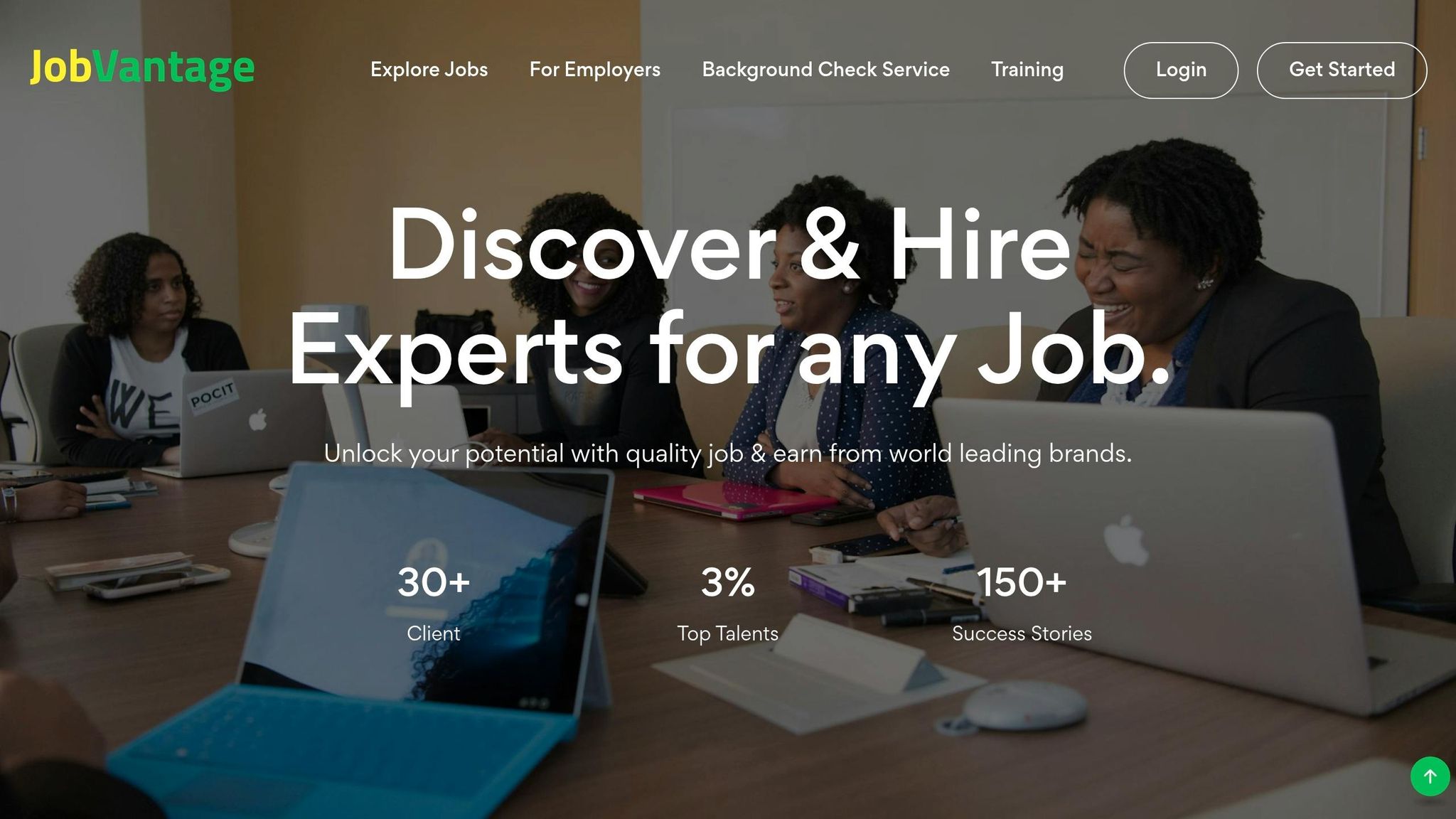
JobVantage is a tool that simplifies the job search process by continuously scanning platforms like LinkedIn, Glassdoor, and Indeed for roles that match specific criteria such as salary, location, and job tenure. One standout feature is its ability to evaluate resumes for Applicant Tracking System (ATS) compatibility. This is a crucial step, as ATS systems filter out up to 75% of resumes before they even reach a recruiter. By identifying skill gaps and enhancing application materials, JobVantage helps users increase interview callbacks by 40% while saving 30–50 hours each month [2].
The tool also integrates with AgentBandwidh's broader network of agents, offering users a more comprehensive view of their career prospects. This interconnected approach ensures that job seekers have access to a wealth of career insights, all in one place.
EdgeFlow: Market Analysis Automation
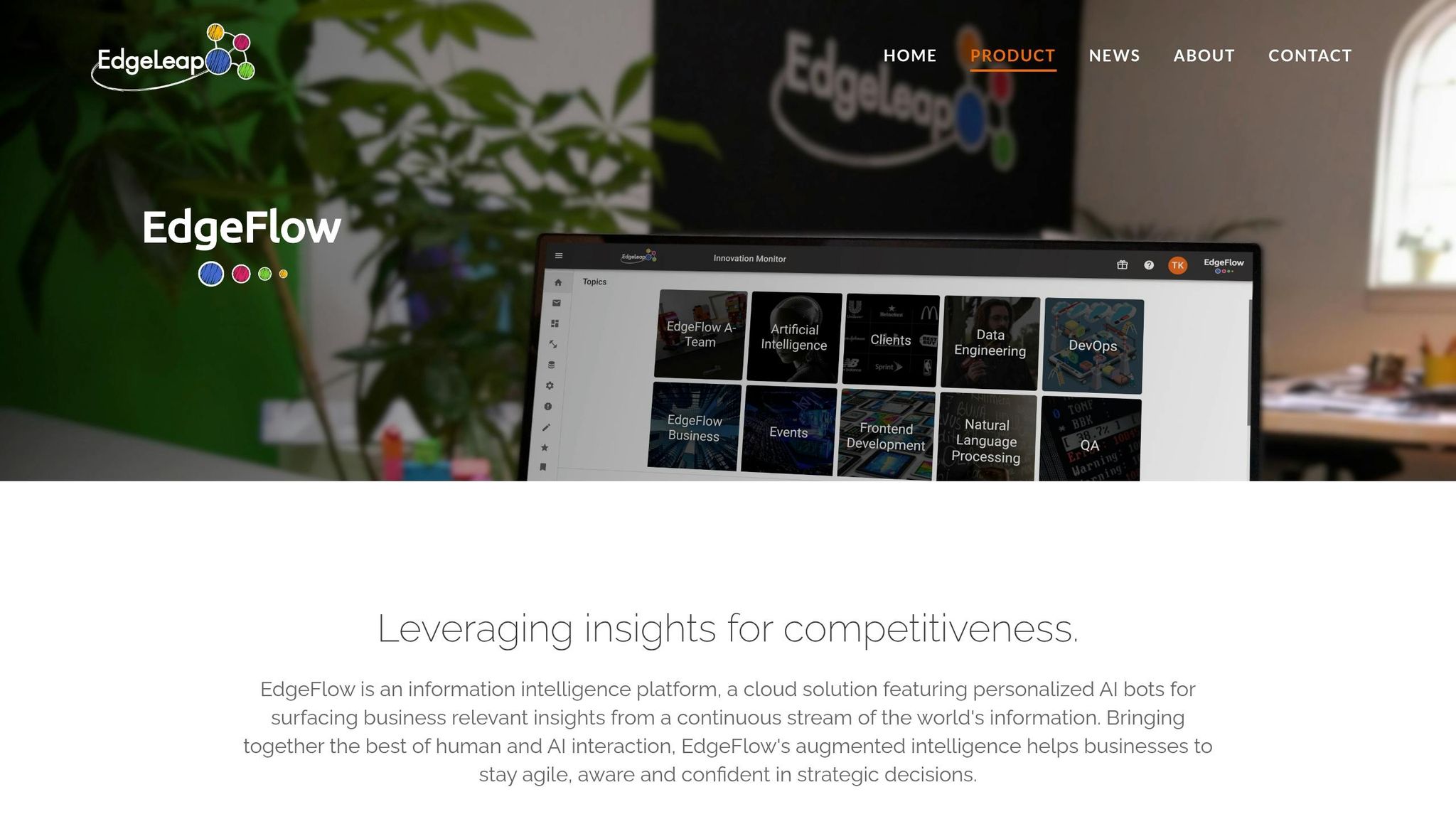
EdgeFlow takes market research to the next level by turning what is usually a periodic task into a continuous stream of real-time insights [17]. It gathers data from sources like public filings, news articles, and internal company documents, eliminating the need for manual data collection [18]. Using a "Mixture of Experts" model, EdgeFlow employs specialized sub-agents to handle tasks such as planning and data routing, ensuring accurate and efficient results [19].
Currently in beta, EdgeFlow uses lightweight AI to pre-score prospects and market opportunities, cutting wasted effort by roughly 40% [16]. This setup combines automation with human oversight, allowing professionals to focus on strategic decisions while the AI takes care of repetitive, data-heavy tasks [17][20]. By blending automation with expert judgment, EdgeFlow delivers actionable insights without compromising on accuracy or context.
Use Cases and Performance Metrics
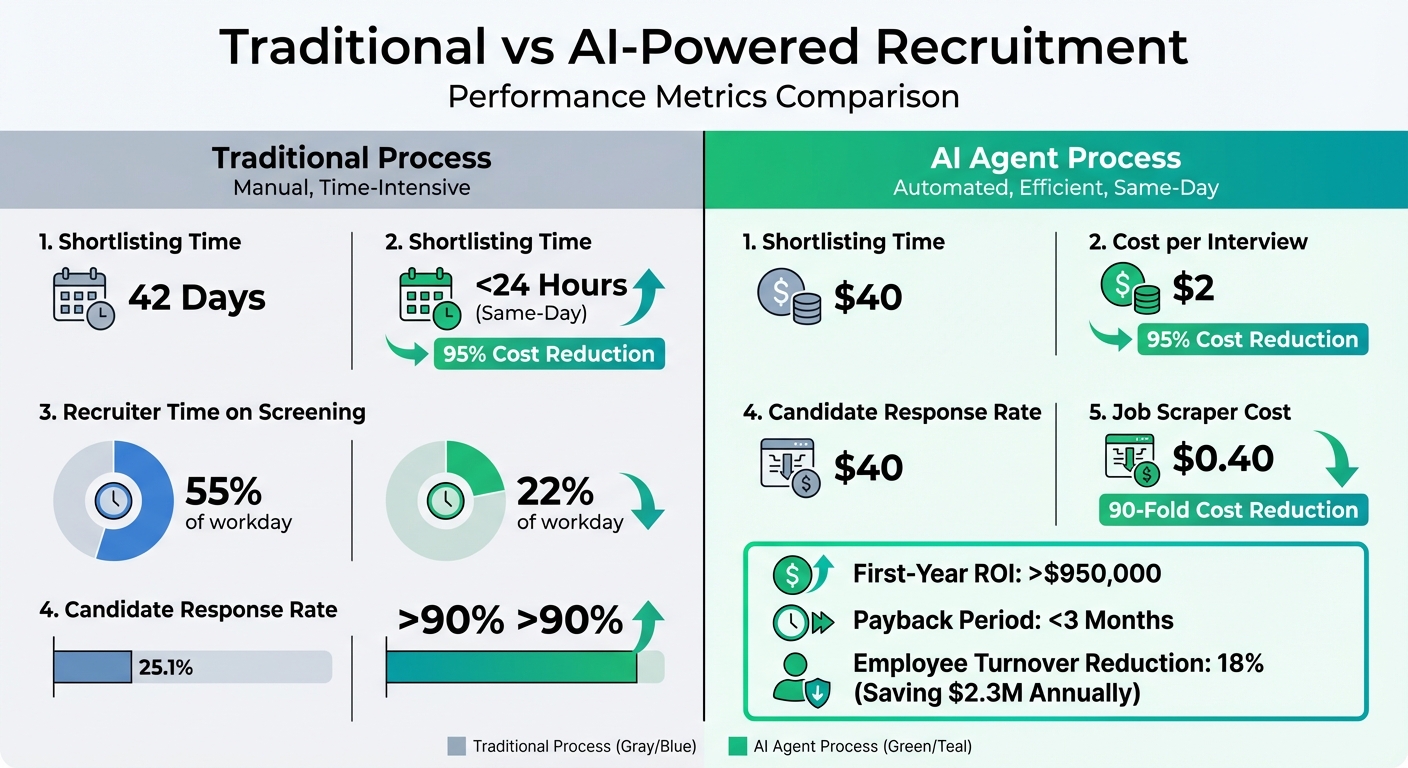
Traditional vs AI-Powered Recruitment: Performance Metrics Comparison
These metrics highlight how AgentBandwidth's tools are reshaping recruitment efficiency and decision-making in the job market.
Case Studies: Efficiency Gains and Success Rates
One mid-sized staffing agency saw dramatic results with AI-powered screening. Their cost per completed interview dropped from $40 to $2, slashing recruitment expenses by 95% [22]. At the same time, candidate response rates jumped from 25.1% to over 90% [22], reducing the number of ignored outreach attempts and enabling more meaningful interactions.
Traditional recruitment timelines, which often required 42 days to shortlist candidates, have been reduced to less than 24 hours [21]. Recruiters who previously spent 55% of their daily work hours manually screening resumes now allocate just 22% to this task [21]. This shift has allowed professionals to reclaim up to 60% of their workday for strategic hiring and relationship-building.
The expense of creating and maintaining job scrapers has also plummeted - from $40 to just $0.40 per unit, representing a 90-fold cost reduction [5]. In one enterprise deployment, the tools delivered a first-year ROI exceeding $950,000 with a payback period of under three months [21].
These examples illustrate the stark differences between traditional hiring methods and AI-driven approaches.
Performance Metrics Comparison
The table below provides a side-by-side look at traditional methods versus AI-powered processes:
| Metric | Traditional Process | AI Agent Process |
|---|---|---|
| Shortlisting Time | 42 Days [21] | Same-Day (<24 Hours) [21] |
| Cost per Interview | $40 [22] | $2 [22] |
| Recruiter Time on Screening | 55% of workday [21] | 22% of workday [21] |
| Candidate Response Rate | 25.1% [22] | >90% [22] |
| Job Scraper Cost | $40 [5] | $0.40 [5] |
Beyond immediate savings, these tools have wider organizational benefits. For example, mid-sized firms using AI talent intelligence have reported an 18% reduction in employee turnover, saving approximately $2.3 million annually [23]. This improvement stems from better candidate-role alignment, thanks to advanced semantic matching that goes beyond basic keyword searches.
Conclusion and Future Trends
Key Takeaways
AI agents are reshaping recruitment by taking over time-consuming tasks like manual screening and streamlining complex workflows. This has led to a noticeable reduction in the time it takes to fill positions. At the same time, AI-driven, multi-channel communication strategies have significantly improved candidate response rates [24][14]. By automating repetitive processes, these tools allow recruiters to focus on more strategic decisions. AgentBandwidh remains at the forefront of these advancements, driving new approaches to recruitment.
What's Next for AI Agents in Job Markets
The efficiency gains we've seen so far are just the beginning. The adoption of self-operating AI agents is on the rise, with predictions showing that 52% of talent leaders will be using them by the end of 2026. The market itself is expected to grow dramatically, from $842.3 million in 2024 to $23.2 billion by 2034 [14][24].
Future developments for AI agents will likely extend beyond candidate sourcing. New applications are emerging, such as predictive attrition modeling, real-time compensation analysis, and ongoing market trend mapping [14][6]. Another exciting trend is the rise of multi-agent systems, where different specialized agents collaborate to manage various stages of the hiring process [1].
Regulatory changes are also shaping the future of AI in recruitment. For instance, the EU AI Act now classifies hiring AI as "high-risk", mandating human oversight, bias testing, and detailed transparency logs [14][24]. By 2027, it’s estimated that 75% of hiring processes will evaluate candidates' ability to work with AI tools [14]. However, there’s still work to be done in building trust - only 26% of applicants currently feel AI evaluates them fairly, and 79% want clear information about how AI impacts their applications [24].
These regulatory and ethical considerations are influencing AgentBandwidh's focus on creating tools that are both compliant and transparent. Moving forward, the key to success will lie in maintaining a balance: letting AI handle data-heavy tasks while relying on human judgment to make final decisions and foster meaningful candidate relationships.
FAQs
How do AI agents decide which jobs are actually a good fit for me?
AI agents review your profile and job descriptions to gauge your skills, experience, and abilities. By leveraging natural language processing (NLP) and machine learning, they assess how closely your qualifications match job requirements, including both technical and soft skills. These systems evolve over time, learning from data and feedback to deliver tailored job suggestions that account for your background and potential for long-term success.
Will using AI to tailor my resume hurt my chances with ATS or recruiters?
Using AI to fine-tune your resume can boost your chances of catching the attention of both ATS systems and recruiters - if used wisely. These tools help align your resume with job descriptions, making it more relevant and easier for ATS algorithms to process. That said, resist the urge to stuff your resume with keywords that don’t genuinely represent your skills. A thoughtful approach ensures your resume remains authentic while striking the right balance between ATS compatibility and recruiter appeal.
What data do AI agents use to forecast job market trends and automation risk?
AI agents rely on a variety of data sources to predict job market trends and evaluate the risks posed by automation. These sources include employment statistics like unemployment rates and payroll data provided by the Bureau of Labor Statistics, as well as metrics tracking AI usage across different professions. By combining traditional labor data with real-time insights into AI adoption, these agents deliver a comprehensive picture of market dynamics and the influence of automation.